
Discount Code
A practical guide to compare the options and choose according to your needs.
Read article
A factual breakdown of the IM8 Daily Ultimate Essentials label: which forms the brand uses, which doses are published, and what to verify before checkout.
 Written by Tim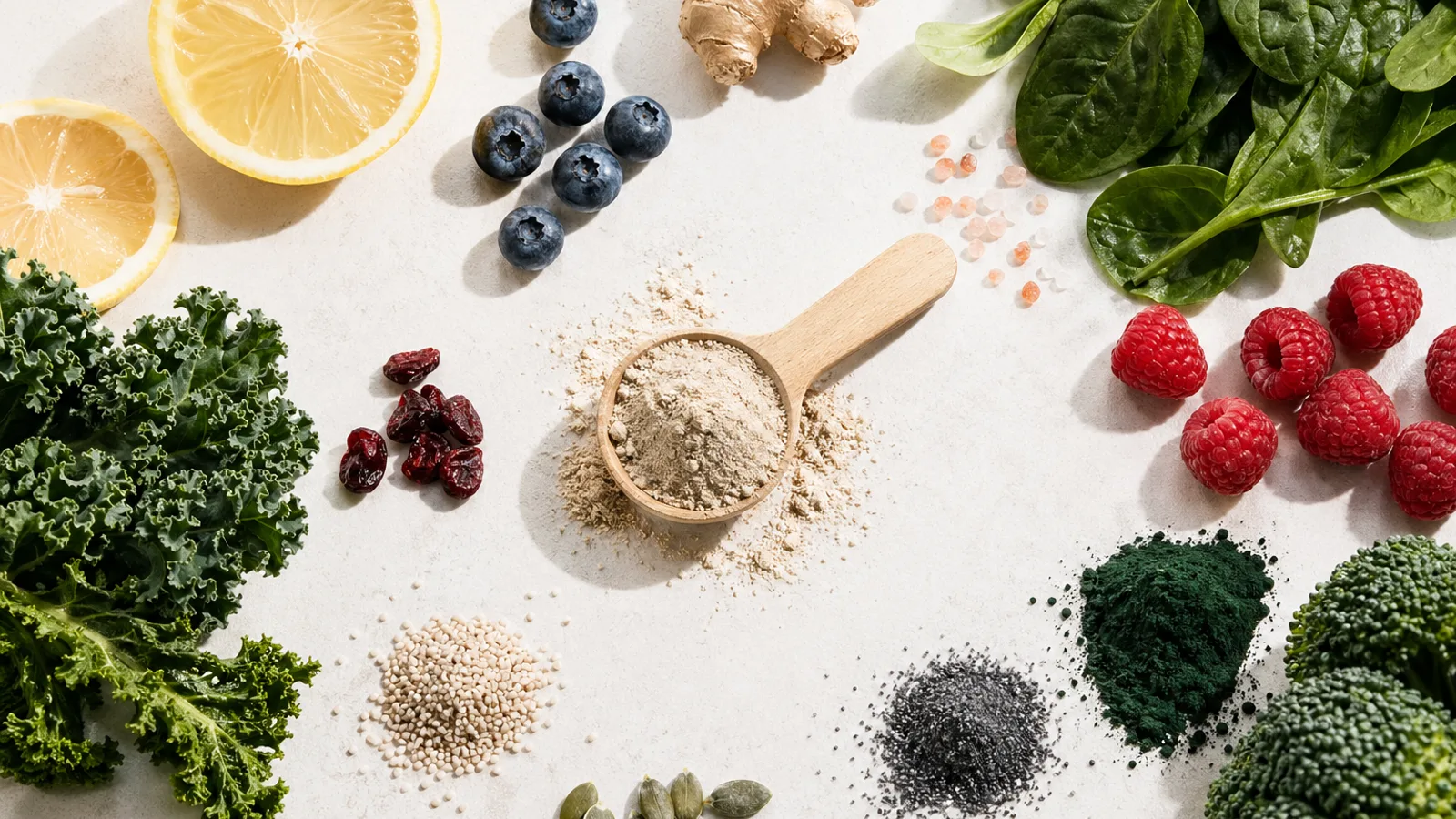
The IM8 label reads like a premium formulation checklist: named forms instead of vague blends for the core vitamins and minerals, published doses for key nutrients, plus themed complexes for greens, probiotics and electrolytes.
That transparency is the main reason the ingredients question usually ends in favor of IM8 for buyers who want one complete daily drink.
If you search for IM8 ingredients, you probably want to know two things: what is actually in the drink, and whether the forms are serious or just marketing. The short answer: the published label of Daily Ultimate Essentials lists around 90 ingredients, and the core vitamins and minerals use named, well-regarded forms rather than anonymous blends. Several doses are published with their daily value percentages, which is more transparency than much of the category offers.
This page goes through the label in detail: the vitamins form by form, the minerals, the seven themed complexes behind the 90 ingredient count, and what all of it means when you compare IM8 against a standard multivitamin. Everything below comes from the ingredients page the brand publishes; it is a label summary, not a medical review. For how the product feels in daily use, taste and value included, see our full IM8 review.
Forms are where premium formulas separate themselves from cheap ones, because active and well-absorbed forms cost meaningfully more to source. The IM8 label names them, so let us read it the way a formulator would.
The B complex is the standout. Vitamin B12 appears as methylcobalamin and folate as Quatrefolic, a glucosamine salt of 5-MTHF: both are methylated, already active forms that skip the conversion step your body otherwise performs. Vitamin B6 is listed as pyridoxal 5-phosphate (P5P), the active coenzyme form that most brands skip to save cost. Riboflavin comes as riboflavin-5-phosphate at a published 4.2 mg per serving, thiamin as thiamin HCl, niacin as flush-free niacinamide, and pantothenic acid as calcium pantothenate at a published 12 mg. Five active or premium forms in one B complex is rare, and it is the single strongest signal on this label.
The fat-soluble vitamins follow the same logic. Vitamin D is listed as VegD3, a plant-based cholecalciferol, the form your skin makes from sunlight. Vitamin K2 appears as all-trans menaquinone-7 (MK-7), the form used in bone health research, and its presence next to D3 matters because the two cooperate in calcium metabolism. Vitamin A is retinyl palmitate at a published 900 mcg RAE, exactly 100 percent of the daily value rather than a showy overdose, and vitamin E is d-alpha tocopheryl succinate, the natural form, at 15 mg. Vitamin C is straightforward ascorbic acid, and biotin covers the hair, skin and nails angle.
If the vocabulary here is new, our sister guide on methylated multivitamins explains why these specific forms matter and how to spot them on any label.
Minerals are the part of a formula where cheap products cut corners hardest, because oxide forms cost a fraction of chelated ones and look identical on a shelf. The IM8 label goes the other way. Magnesium appears as magnesium bisglycinate chelate, the well-tolerated, well-absorbed form that quality formulas use. Zinc is zinc citrate, selenium is selenomethionine, and copper and manganese are both citrates. Calcium is a combination of calcium citrate and tricalcium phosphate, iodine comes as potassium iodide, and the label rounds out with molybdenum as an amino acid chelate and boron as an amino acid complex, two trace minerals most multivitamins skip entirely.
Also worth noting for the over 50 audience: iron is not among the highlighted minerals on the published ingredients page, which aligns with how thoughtful adult formulas are built, since routine iron supplementation without a tested deficiency is generally discouraged after menopause. The electrolyte side, sodium and potassium included, lives in its own complex covered below.
Beyond the core vitamins and minerals, the label organizes the rest of the formula into themed complexes: a raw superfoods, greens, fruits and herbs complex carrying the produce-derived ingredients, including antioxidant sources like spinach leaf with its lutein and zeaxanthin; a probiotics complex; a joint and muscle vitality section; hydra electrolytes for the hydration minerals; heart health support, where the published 100 mg of CoQ10 in a bioavailable form lives alongside citrus bioflavonoids; and an essential amino and renew complex covering the amino acid side. This is how the ingredient count reaches roughly 90 while the drink stays one scoop.
Complexes are the honest nuance of this label, and you should understand them before buying. They group several ingredients under one banner, which keeps the panel readable but means individual doses inside a complex are not always broken out. That is common practice across the entire all-in-one category, including the competitors people compare in our IM8 vs AG1 breakdown, and it is the structural trade-off of wanting ninety ingredients in one serving: full itemization would need a poster, not a label. The fair way to judge it: the core nutrients where doses matter most are itemized with forms and amounts, and the complexes carry the botanical breadth.

Code verified and valid for 2026
Step back from the individual lines and a pattern appears. Every place where a cheap and a premium option exist, this label picks the premium one: methylated B vitamins instead of commodity forms, bisglycinate instead of oxide, natural vitamin E instead of synthetic, MK-7 instead of no K2 at all, trace minerals included instead of skipped. Formulation choices like these are invisible in marketing photos and expensive in production, which makes them a more reliable quality signal than any slogan.
That pattern is also the fair answer to the price question. IM8 sits at a premium price point, and the label is where that price goes: forms, breadth and published doses. Whether that is worth it depends entirely on what it replaces in your routine. A buyer consolidating a multivitamin, a greens powder, an electrolyte mix and a probiotic into one scoop is buying value; a buyer who needs exactly one nutrient is overpaying for breadth they will not use. Our full review runs that math honestly.
Three checks take two minutes and prevent most bad purchases. First, scan the forms: the named forms above should appear on the supplement facts panel at checkout, and if a formula update ever swapped one, the checkout label is where you would see it. Second, look at what you already take: an all-in-one drink overlaps quickly with separate B vitamins, magnesium, electrolyte or greens products, and stacking the same nutrients twice serves nobody; line up your current bottles against this label and plan which ones the drink retires. Third, check the allergen and dietary notes on the official page if you follow a specific diet, vegan sourcing of D3 included.
If the formula fits, the remaining question is price, and that is where the verified IM8 discount code matters: the label does not change between full price and discounted price, so the code is the lever on value per serving. And if tolerance is your concern rather than composition, our IM8 side effects guide covers what first-time users should actually watch.
Code verified and valid for 2026
IM8 presents Daily Ultimate Essentials as an all-in-one formula with around 90 nutrient ingredients, organized in vitamins, minerals and themed complexes such as greens, probiotics, electrolytes and amino acids. The exact list is published on the official ingredients page.
Yes, according to the published label: vitamin B12 appears as methylcobalamin, folate as Quatrefolic (a 5-MTHF form) and vitamin B6 as pyridoxal 5-phosphate. All three are active, already converted forms that premium formulas increasingly prefer.
The label lists vitamin D as VegD3, a plant-based cholecalciferol. As always, check the current official label for full ingredient sourcing before buying if this point matters to you.
Iron does not appear among the highlighted minerals on the published ingredients page, which lists zinc, magnesium, calcium, iodine, copper, manganese, selenium, molybdenum and boron. Check the current supplement facts panel at checkout for the definitive answer, as formulas can evolve.
The label groups the non-vitamin portion of the formula into themed complexes: raw superfoods, greens, fruits and herbs; probiotics; joint and muscle vitality; hydra electrolytes; heart health support; and an essential amino and renew complex. Complexes keep the panel readable but pool several ingredients per banner.
On the official IM8 website, which publishes an ingredients page with forms and several per-serving amounts. The label at checkout always takes precedence over any third-party summary, including this one.
To continue reading, also see Discount Code, IM8 vs AG1 and IM8 Reviews.
Partner offer IM8 Daily Ultimate Essentials is the main product behind the IM8 discount code search intent: a p...